
Obesity & Metabolic Surgery
Revisional Bariatric Surgery in Antalya
Assessment and correction of previous weight loss operations that have caused complications or not achieved the expected result — performed laparoscopically by Dr. Mani Habibi.
Ask Dr. Habibi a Question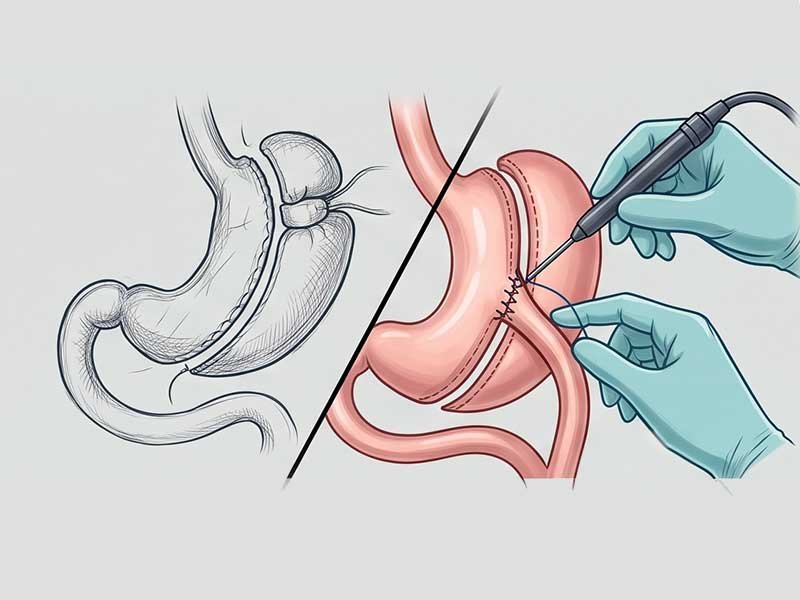
- Procedure
- Laparoscopic revision or conversion
- Anaesthesia
- General anaesthesia
- Operating time
- Longer than a first operation; varies by case
- Hospital stay
- Usually 3–5 nights
- Return to work
- Typically 3–4 weeks
What is revisional bariatric surgery?
Revisional bariatric surgery is a second operation performed on a patient who has already had a weight loss procedure. It is carried out either to treat a complication of the first operation — such as severe reflux, a stricture or a fistula — or because the expected weight loss was not achieved or has been substantially regained. Depending on the problem, a revision may correct the existing anatomy or convert it to a different procedure, most commonly from sleeve gastrectomy to gastric bypass.
Revision surgery is technically more demanding than a first operation. Scar tissue from the previous procedure alters the anatomy, tissue planes are less clearly defined, and complication rates are higher. For this reason it should be undertaken only after thorough investigation and by a surgeon experienced in bariatric revision.
Why might a revision be needed?
The most common reasons patients are assessed for revisional surgery are:
- Severe reflux after sleeve gastrectomy that does not respond to medication — the single most frequent reason for conversion to gastric bypass
- Insufficient weight loss, where a substantial proportion of excess weight was never lost despite good adherence
- Significant weight regain, sometimes associated with an enlarged pouch or dilated sleeve
- Mechanical complications such as stricture, chronic fistula, an obstructing band, or a persistent staple-line problem
Before any revision is considered, the cause must be identified. Investigation typically includes gastroscopy, contrast imaging of the stomach, blood tests and a detailed dietary review. Weight regain driven by eating patterns alone is often better addressed with structured dietary and behavioural support than with a second operation — and Dr. Habibi will say so where that is the case.
Important: Revision is not a routine "top-up" procedure. It carries higher risk than a first operation and is appropriate only when a clear anatomical or medical reason has been established by investigation.
Which revision options exist?
Sleeve to gastric bypass
The most common conversion. Used for severe reflux after a sleeve, and often for insufficient weight loss, as bypass generally improves both.
Re-sleeve
Where a sleeve has dilated significantly but there is no reflux, the stomach may be re-shaped rather than converted.
Band removal and conversion
Gastric bands that have slipped, eroded or simply not worked are removed, and converted to a sleeve or bypass where appropriate.
Repair of a specific complication
Targeted correction of a stricture, hiatal hernia, chronic fistula or enlarged pouch without changing the overall procedure type.
What does recovery look like?
What results can be expected after revision?
Expectations should be set carefully. Where revision is performed for a complication such as reflux, published outcomes report high rates of symptom improvement after conversion to bypass. Where it is performed for weight regain, additional weight loss is generally more modest than after a first operation, and depends heavily on dietary adherence and follow-up. Revision does not reset the process, and no specific outcome can be guaranteed.
What are the risks of revision surgery?
Revision carries all the risks of a first bariatric operation, at a somewhat higher rate because of scar tissue and altered anatomy:
- Early: bleeding, leak at a staple or suture line, infection, blood clots, reaction to anaesthesia
- Later: stricture, marginal ulcer, internal hernia after conversion to bypass, and vitamin and mineral deficiencies
- Outcome-related: weight loss that falls short of expectations, or persistence of the original symptom
Because of this elevated risk profile, the decision to revise is always a balance: the problem being corrected must be significant enough to justify a second operation. That judgement is made together, after the investigations are complete.
Which revision suits which problem?
| Problem after first surgery | Commonly considered option | Notes |
|---|---|---|
| Severe reflux after sleeve | Conversion to gastric bypass | Generally the most effective option for reflux |
| Dilated sleeve, no reflux | Re-sleeve or conversion to bypass | Choice depends on imaging and endoscopy findings |
| Insufficient weight loss | Conversion to bypass | Dietary causes must be excluded first |
| Gastric band problem | Band removal ± conversion | May be done in one or two stages |
| Stricture or fistula | Targeted repair | Endoscopic treatment is sometimes possible first |
| Weight regain, normal anatomy | Dietary and behavioural support | Surgery is often not the right answer here |
This table is a general guide, not a treatment plan. The right option depends on endoscopy and imaging findings, symptoms, previous operative notes and overall health. Read more about gastric bypass surgery.

General surgeon specialising in obesity and metabolic surgery in Antalya, Türkiye. Trained in bariatric surgery at the Cleveland Clinic (USA), recipient of the EAES Fellowship Award 2018, IFSO member, co-author of 40+ peer-reviewed publications. Full profile →
FAQ
Revisional surgery — frequently asked questions
When is revisional bariatric surgery necessary?
Revision is considered when a previous weight loss operation has caused a complication — most often severe reflux, a stricture or a fistula — or when a substantial part of the excess weight was never lost or has been regained, and investigation shows an anatomical cause.
Can a gastric sleeve be converted to a gastric bypass?
Yes. Conversion from sleeve gastrectomy to Roux-en-Y gastric bypass is the most frequently performed bariatric revision. It is used particularly for severe reflux after a sleeve, and also where weight loss has been insufficient.
How much extra weight is lost after a revision?
Additional weight loss after revision is generally more modest than after a first operation and varies widely between patients. Where revision is performed to correct a complication such as reflux, symptom relief rather than weight loss is the primary goal.
Is revision surgery riskier than the first operation?
Yes. Scar tissue from the previous operation makes the anatomy less predictable and the dissection more demanding, so complication rates are higher than for a first procedure. This is why revision is undertaken only with a clear indication and after full investigation.
I had surgery abroad — can Dr. Habibi still assess me?
Yes. Patients who had their first operation elsewhere are frequently assessed for revision. Bringing the original operative report, discharge summary and any endoscopy or imaging results makes the assessment considerably more accurate.
How long do international patients stay for a revision?
Usually seven to ten days — longer than for a first operation, because investigations are more extensive beforehand and monitoring is more cautious afterwards.
Is a second operation always the answer to weight regain?
No. Where investigation shows the anatomy is intact and regain is driven by eating patterns, structured dietary and behavioural support is usually the more appropriate route. Surgery is recommended only where a correctable anatomical cause is found.
Related Procedures
Other bariatric options
Considering a revision?
Send your previous operative report, discharge summary and any recent endoscopy or imaging results. Dr. Habibi will review them personally before advising on next steps.
Message on WhatsApp